


Think about the last time you Googled something. Did you click a result — or did the answer just appear right there on the page? Maybe you asked ChatGPT instead of Google. Or let Alexa handle it. That subtle shift in habit is reshaping the entire digital marketing industry, and if your strategy still revolves exclusively around traditional search rankings, you’re already losing ground.
The question everyone in digital marketing is asking right now is: what is SEO, GEO, and AEO — and how do these three disciplines fit together in today’s AI-powered search environment? This article answers that question thoroughly, without fluff, so you can build a search visibility strategy that actually works in 2026.
What Is SEO, GEO, and AEO? A Quick Overview
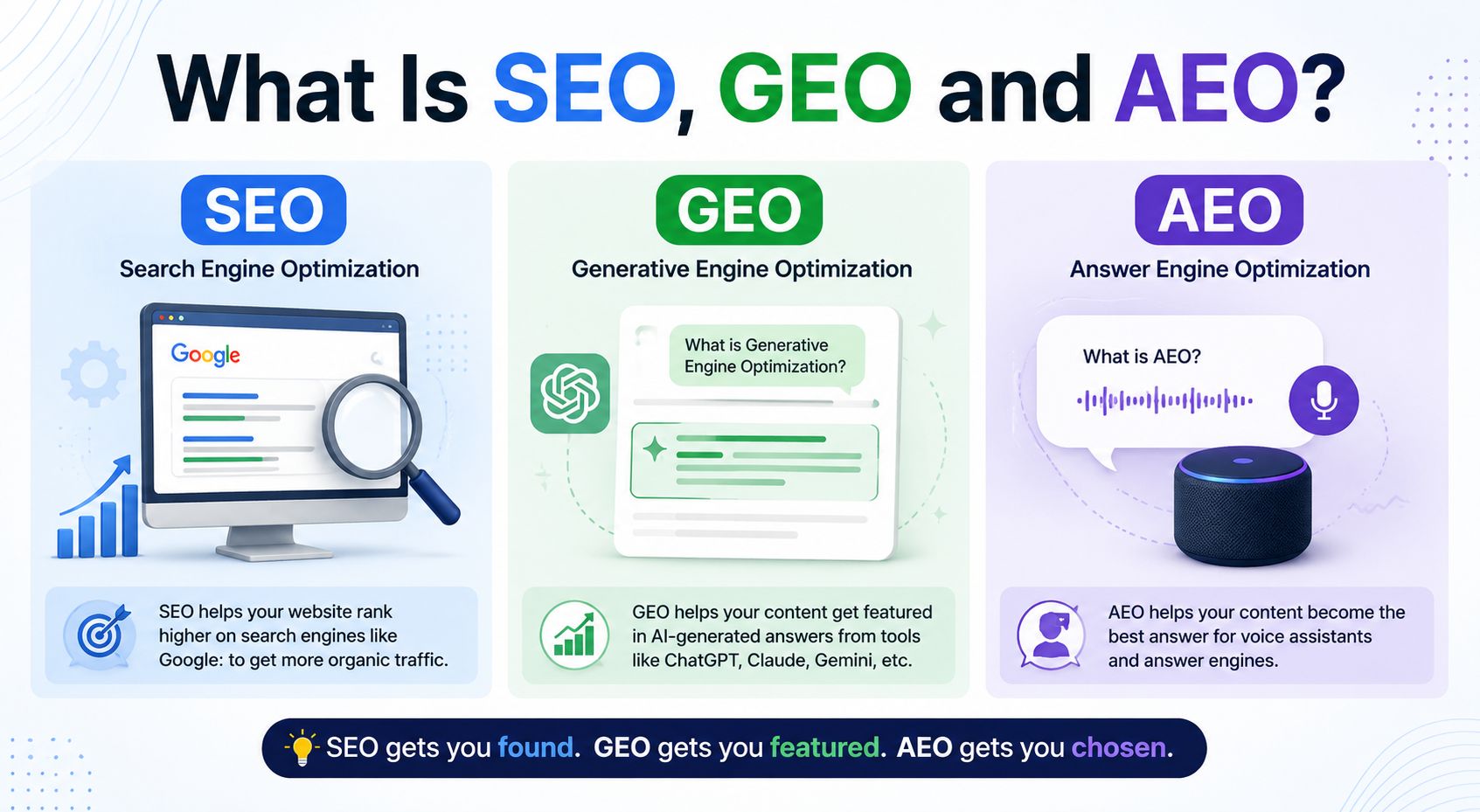
Let’s establish the basics before diving deep. These three acronyms represent three distinct — yet deeply connected — layers of modern search optimization.
SEO (Search Engine Optimization) is the practice of improving your website’s visibility on traditional search engines like Google and Bing. It’s been around for nearly 30 years and remains the foundation of organic digital visibility.
AEO (Answer Engine Optimization) is about making your content the direct answer to a question — the kind that gets surfaced in featured snippets, voice assistant responses, and AI-generated overviews. The goal isn’t just to rank; it’s to be chosen as the answer.
GEO (Generative Engine Optimization) is the newest layer. When someone asks ChatGPT, Gemini, or Perplexity a question, those tools synthesize an answer by pulling from trusted web sources. GEO is the art and science of making sure your content is one of those sources — getting cited in AI-generated responses.
Together, these three strategies form what experts are calling the new visibility stack. Miss one layer, and you miss a growing segment of how people find information online.
Understanding SEO: The Foundation You Cannot Skip
What Is SEO (Search Engine Optimization)?
Search Engine Optimization is the process of making your website easier for search engines to find, understand, and rank higher in organic search results. When someone types a query into Google or Bing, a complex algorithm evaluates hundreds of ranking signals to determine which pages deserve the top spots. SEO is how you influence those signals in your favor.
It covers everything from the words you use on a page to how fast your site loads on a mobile device. It’s not a one-time task — it’s an ongoing discipline that evolves as search algorithms evolve.
The Three Pillars of SEO
On-Page SEO
This is what most people think of when they hear “SEO.” On-page optimization involves crafting content around relevant keywords, structuring your headings logically, writing compelling meta descriptions, and ensuring your content genuinely satisfies the searcher’s intent. Good on-page SEO means a real human — and a search engine crawler — can immediately understand what your page is about and why it’s valuable.
Off-Page SEO
Your website’s authority is largely measured by what other websites say about it. Backlinks — links from other reputable sites pointing to yours — remain one of the strongest ranking signals in existence. Off-page SEO also includes brand mentions, social signals, and digital PR. If authoritative outlets are talking about you, search engines take notice.
Technical SEO
Even the best content can fail if search engines can’t crawl and index it efficiently. Technical SEO addresses site speed, mobile-friendliness, clean URL structures, XML sitemaps, schema markup, and Core Web Vitals. Think of it as the infrastructure that allows everything else to work. Without it, your content exists in a digital dark room.
Is SEO Still Relevant in 2026?
Absolutely — and anyone telling you otherwise is oversimplifying. Traditional search still processes billions of queries every single day. Google hasn’t disappeared. What has changed is the competitive landscape around organic results. AI Overviews now sit above the traditional blue links. Featured snippets dominate mobile screens. Zero-click searches are surging.
The point isn’t that SEO is dying. The point is that SEO alone is no longer sufficient. It’s the bedrock on which AEO and GEO are built — you cannot have strong generative search visibility without first having strong content authority, and that authority is built through SEO.
What Is AEO (Answer Engine Optimization)?
Defining AEO
Answer Engine Optimization is the practice of structuring and enhancing your content so that AI-powered search platforms and voice assistants select it as the cited source when generating direct answers. Where SEO asks “how do I rank?”, AEO asks “how do I become the answer?”
The shift toward answer engines has been building for years. It started with Google’s featured snippets — those boxed answers at the top of the results page. Then came voice search with Siri, Alexa, and Google Assistant. Now, with AI Overviews and conversational AI platforms like ChatGPT and Perplexity embedded into everyday search habits, the answer engine layer has become unavoidable.
Why AEO Matters Right Now
of Google searches ended without a click in 2025 — up from 56% in 2024. If your strategy depends entirely on clicks, a growing majority of searches are passing you by completely.
ChatGPT now handles over 2 billion queries daily and has more than 883 million monthly users. Google AI Overviews appear in nearly 55% of all Google searches. Voice assistants answer questions directly, without sending users to a website. The searcher’s journey has fundamentally changed — and if your content isn’t structured to be the answer, it simply won’t show up.
There’s also a competitive gap worth noting. Around 70% of organizations believe AEO will significantly impact their digital strategy within the next one to three years. Yet only 20% have started implementing it. That gap represents a massive opportunity for businesses willing to move now.
How AEO Differs From SEO
SEO and AEO share the same foundation — quality content, technical health, and authority signals — but they serve different purposes. SEO gets you onto the results page. AEO determines whether your content gets selected when an AI system generates a direct answer above those results.
With traditional SEO, a user sees your page listed among results and decides whether to click. With AEO, the AI reads your content, extracts the answer, and presents it to the user — sometimes without the user ever visiting your site. Your visibility isn’t measured in rankings; it’s measured in citations and answer placements.
AEO Best Practices
Write in a Question-and-Answer Format
Structure your content around the real questions your audience types into search. Use the question as a heading (H2 or H3), then answer it clearly and concisely in the paragraph immediately beneath. Don’t bury the answer. Don’t make the reader scroll for it. AI systems and voice assistants reward content that gets straight to the point.
Open Every Page with a Direct Answer
Open every key page or section with a clean 40 to 60-word answer. Large language models scan for exactly this kind of extractable content. If your opening paragraph is vague, meandering, or stuffed with filler phrases, the algorithm moves on to a competitor who answered more clearly.
Implement Structured Data and Schema Markup
Schema markup — particularly FAQ schema, HowTo schema, and Article schema — signals to search engines and AI crawlers exactly what type of content lives on your page. This dramatically increases the likelihood of your content being surfaced in AI-generated overviews and voice results. It’s a technical investment that pays disproportionate returns for AEO.
Build Your E-E-A-T Signals
Experience, Expertise, Authoritativeness, and Trustworthiness (E-E-A-T) are the backbone of AEO credibility. AI systems are trained to favor content from demonstrably expert, authoritative sources. Include author bios with credentials, cite your sources, publish original research, and keep your content factually accurate and up to date.
What Is GEO (Generative Engine Optimization)?
Defining GEO
Generative Engine Optimization is the strategy of crafting authoritative, well-structured content that AI tools and generative search engines draw from when synthesizing their responses. It’s about being a source that AI trusts — not just a page that ranks.
When you ask ChatGPT a question, it doesn’t just retrieve a link. It reads across dozens of sources, synthesizes the most credible and useful information, and constructs a coherent answer — sometimes citing the sources inline. GEO is how you get your content into that synthesis process. It’s the first creator-focused framework specifically designed for optimizing visibility inside generative AI platforms rather than traditional ranked lists.
How Generative AI Search Engines Work
Understanding the mechanics behind generative search helps clarify exactly what GEO is optimizing for. When a user submits a complex question, the AI doesn’t copy that entire prompt into a search engine. Instead, it breaks the query down into several smaller sub-queries — a process called fan-out querying.
For example, if someone asks “What’s the best project management tool for a remote startup with a tight budget?”, the AI might simultaneously search for “best project management tools 2026,” “project management software pricing comparison,” and “tools for remote teams.” Your content needs to rank for these component sub-queries, not just the parent question. This is a fundamentally different optimization target than traditional SEO.
AI systems then evaluate source credibility based on signals like domain authority, the recency and factual accuracy of the content, how well the content is structured, and how frequently the source is referenced by other trusted sources online. Only after passing those filters does your content become a candidate for citation.
GEO vs. Traditional SEO: Key Differences
The differences are real, and they matter for how you allocate your content strategy effort.
With traditional SEO, the flow is linear: you optimize for visibility → a user clicks your link → they arrive on your site → you convert them. Success is measured in rankings and click-through rates.
With GEO, the flow is different: you optimize to become an authoritative source → AI cites or incorporates your content → your brand gains visibility and credibility inside the AI’s response — whether or not the user ever clicks through to your site. Success is measured in brand mentions, share of voice in AI answers, and AI-referred traffic.
GEO targets AI platforms and rewards content structure, factual clarity, and citation potential. SEO targets traditional search engines and rewards keyword alignment, backlinks, and site performance. Both matter. Neither replaces the other.
GEO Best Practices
Create Data-Driven, Authoritative Content
Generative AI systems have a strong preference for original data, proprietary research, and expert-backed insights. Generic content — the kind that restates what everyone else has already said — is at risk of being overlooked entirely. Publish original case studies, industry benchmarks, unique data points, and first-person expertise that no competitor can replicate. That’s what AI engines treat as citation-worthy.
Build a Strong Off-Site Reputation
Your website is just one part of your credibility footprint. Reviews, press coverage, expert mentions in industry publications, partner page references, and contributor bios all become part of the evidence web that generative AI systems use to evaluate whether your brand is trustworthy enough to cite. In 2026, AI search systems may privilege authoritative third-party sources even more strongly than classic search algorithms. Getting featured in a “top tools” roundup or an industry publication isn’t just good for PR — it’s a direct GEO signal.
Ensure AI Crawlers Can Access Your Content
This is a technical point that many brands overlook. AI bots — including the crawlers used by ChatGPT, Perplexity, and Google’s AI systems — need to be able to discover and read your pages. If your robots.txt file is inadvertently blocking these crawlers, or your content sits behind authentication walls, generative AI simply cannot include it. Audit your crawl settings specifically for AI bot agents like “GPTBot” and “PerplexityBot.” Make your best content fully accessible.
Use Consistent, Structured Language
Write clearly. Use headings that describe what each section contains. Define your terms. Avoid jargon unless you also explain it. When AI systems parse your content, they’re looking for clarity, logical structure, and factual precision — not clever metaphors or vague brand language. The more cleanly your content communicates, the more confidently an AI will draw from it.
SEO vs. AEO vs. GEO — Side-by-Side Comparison
Understanding how these three disciplines relate to each other becomes much clearer when you look at them side by side. Here’s the breakdown across the dimensions that matter most for your strategy.
| Aspect | SEO | AEO | GEO |
|---|---|---|---|
| Primary Goal | Rank high in search results | Be the direct answer to a query | Get cited in AI-generated responses |
| Target Platform | Google, Bing (traditional SERPs) | Voice assistants, featured snippets, AI Overviews | ChatGPT, Gemini, Perplexity, Copilot |
| User Behavior | Types keywords, clicks links | Asks direct questions, wants instant answers | Prompts AI, reads synthesized responses |
| Success Metric | Keyword rankings, organic traffic | Answer placements, zero-click visibility | AI citations, brand mentions in responses |
| Key Content Type | Blog posts, landing pages, service pages | FAQ pages, how-to guides, concise definitions | Research reports, data studies, authoritative guides |
| Core Tactics | Keywords, backlinks, technical health | Schema markup, Q&A formatting, E-E-A-T | Authority building, structured content, off-site reputation |
Notice that none of these strategies fundamentally conflict with each other. They all reward quality content, technical accessibility, and demonstrated expertise. The difference lies in where you’re trying to be visible and how that visibility is measured.
Why You Need All Three — Not Just One
The Hybrid Future of Search
Search in 2026 is not one thing. It’s a hybrid ecosystem. Some users still type keywords into Google and scroll through blue links. Others ask full questions to ChatGPT and never visit a single website. Others use voice assistants while commuting. Others get answers directly in AI Overviews without ever scrolling down. You cannot predict which channel your next customer will use — so you need to be present in all of them.
Search optimization now requires three complementary disciplines, each serving a different purpose in how users discover information. Miss one layer and you’re invisible to an entire segment of your audience.
How They Work Together
Think of it as a layered funnel. SEO builds the foundation — it establishes your content’s authority, technical health, and topical relevance. AEO wins the snippet — it ensures your content is formatted in a way that answer engines can extract and display directly. GEO earns the AI citation — it makes your brand the trusted source that generative platforms draw from when constructing their synthesized answers.
GEO and AEO enhance rather than replace SEO, because generative engines still rely on many of the same authority and relevance signals that traditional search algorithms use. A domain with poor SEO fundamentals — thin content, weak backlink profile, slow load times — will struggle to earn GEO citations no matter how well its content is structured. The disciplines reinforce each other.
How to Build an Integrated SEO + AEO + GEO Strategy
Knowing what these strategies are is only useful if you can act on them. Here’s a practical, step-by-step approach to building a unified visibility strategy across all three disciplines.
-
Audit Your Current SEO Health
Before layering in AEO or GEO tactics, make sure your technical SEO foundation is solid. Ensure your site is fast, mobile-friendly, properly indexed, and free of crawl errors. Fix broken links, duplicate content, and thin pages. A weak SEO foundation will limit the effectiveness of everything built on top of it.
-
Identify the Questions Your Audience Is Asking
Move beyond keyword volume. Research the actual questions your target audience types into search, asks voice assistants, and prompts into AI platforms. Use tools like “People Also Ask,” search autocomplete, and conversational AI platforms themselves to uncover the language your audience uses. These questions become your AEO and GEO content targets.
-
Structure Content for Answer Extraction
Reformat your best pages to lead with a direct, concise answer — ideally within the first 60 words. Use question-based headings. Add FAQ sections to your key service and resource pages. Implement schema markup, especially FAQ, HowTo, and Article schema. Every structural improvement you make for AEO simultaneously signals clarity to GEO systems.
-
Build Topical Authority and Off-Site Credibility
Create content clusters that demonstrate deep expertise on your core topics. Pursue press coverage, guest contributions, and expert mentions in reputable industry publications. Collect and respond to reviews. Ensure your brand information is consistent across every platform where AI systems might encounter it. Authority in GEO is built in public — not just on your own website.
-
Optimize for AI Crawlers (Technical GEO)
Review your robots.txt file and server configurations to ensure AI crawlers — including GPTBot, PerplexityBot, and Google’s AI bots — are not blocked. Ensure your highest-value content is publicly accessible and not gated behind logins or JavaScript rendering issues. The content AI can’t read is content AI can’t cite.
-
Measure What Actually Matters
Traditional SEO metrics like keyword ranking and organic click volume are still relevant but incomplete. You also need to track brand citations in AI responses, share of voice in AI-generated answers, referral traffic from AI platforms, and sentiment in how AI systems describe your brand. These new metrics tell you whether your GEO and AEO efforts are working — and where to refine them.
The Role of E-E-A-T Across All Three Disciplines
E-E-A-T — Experience, Expertise, Authoritativeness, and Trustworthiness — is no longer just a Google quality guideline. It’s become the universal credibility framework across SEO, AEO, and GEO alike.
For traditional SEO, E-E-A-T signals influence how Google’s quality raters assess your content and, by extension, how algorithms rank it. For AEO, it determines whether AI Overviews and voice assistants trust your content enough to surface it as a direct answer. For GEO, it’s perhaps the most critical factor of all — generative AI systems are specifically calibrated to draw from authoritative, trustworthy sources.
Your reviews, press features, expert mentions, partner page references, and contributor bios have become part of the evidence web that AI systems use to determine whether your brand deserves to be cited. Research consistently shows that AI search systems may privilege authoritative third-party sources even more strongly than classic search rankings. The implication is clear: building your brand’s public credibility is no longer optional — it’s a core optimization activity.
Common Mistakes Businesses Make
Ignoring AEO and GEO Entirely
This is the most widespread mistake. Many businesses are still operating on a purely traditional SEO playbook — measuring success exclusively by keyword rankings and organic traffic volume. That model is increasingly incomplete. As traditional search volume migrates toward AI-powered platforms, brands that haven’t invested in AEO and GEO are becoming invisible to a growing share of their audience.
Treating SEO, AEO, and GEO as Separate Silos
These three disciplines share the same fundamental inputs: quality content, technical accessibility, and demonstrated authority. Running them as separate teams with separate budgets and separate strategies is both inefficient and counterproductive. The strongest approach integrates all three into a unified content and visibility strategy, where improvements in one area naturally reinforce the others.
Neglecting Technical Accessibility for AI Bots
You can produce the most authoritative content in your industry and still be invisible to generative AI if your site is inadvertently blocking AI crawlers. This is a surprisingly common technical oversight. Cloudflare’s default settings, for example, have been known to block AI bots automatically. Regularly audit your site’s crawl accessibility specifically for the bots that power GEO — it takes minimal effort and can have an outsized impact.
Focusing on Keywords Instead of Questions
Keyword-first thinking produces content that looks good in a spreadsheet but misses how people actually behave in AEO and GEO environments. In AI-powered search, users write full sentences. They ask follow-up questions. They have a conversational exchange with the AI. Content optimized exclusively around short-tail keywords is poorly equipped for this reality. Shift your research from keyword volume toward question intent.
Expecting Overnight Results
Building AI visibility is a long game. GEO citation authority accumulates over time, much like backlink profiles in traditional SEO. Brands that start now — building topical authority, structuring content for answer extraction, and earning off-site credibility — will have a compounding advantage over those who wait until the shift is undeniable. The best time to invest was two years ago. The second-best time is now.
The Future of Search: What’s Coming Next
The trajectory is clear. Gartner predicts a 50% decline in conventional search traffic by 2028, with the bulk of that volume migrating to generative AI platforms. Even if the exact number shifts, the directional trend is indisputable — AI-powered search is not a passing fad. It’s a structural evolution in how humans find and consume information online.
Beyond GEO and AEO, a fourth layer is emerging: AAO (AI Agent Optimization) — optimizing your brand’s presence for autonomous AI agents that browse, compare, and make decisions on behalf of users. In this future, your content may be evaluated not by a human reading it, but by an AI agent recommending your product or service as part of an automated workflow.
This isn’t science fiction — it’s already beginning. The businesses best positioned for this next phase are exactly the ones building strong AEO and GEO foundations today. Trustworthy, structured, authoritative content is the common denominator across every layer of AI-powered visibility, present and future.
This is not about abandoning SEO. It’s about evolving your understanding of what “visibility” means in a world where your audience’s first interaction with your brand may be mediated entirely by an AI.
Frequently Asked Questions
Q1. What is the difference between SEO, GEO, and AEO in simple terms?
SEO helps your website rank on Google’s results page. AEO helps your content become the direct answer in featured snippets, voice responses, and AI Overviews. GEO ensures your content gets cited when generative AI tools like ChatGPT or Perplexity synthesize an answer for a user. SEO is about ranking; AEO is about answering; GEO is about being cited as a trusted source.
Q2. Do I still need SEO if I focus on GEO and AEO?
Yes — without exception. SEO provides the technical and authority foundation that GEO and AEO depend on. Generative engines and answer engines still rely on the same core signals that traditional search algorithms use: content quality, domain authority, technical health, and topical relevance. GEO and AEO don’t replace SEO; they build on top of it.
Q3. What types of content work best for AEO and GEO?
Research reports, data-driven articles, comprehensive FAQ pages, detailed how-to guides, and well-structured topic comparisons perform strongly across both AEO and GEO. Original data — benchmarks, surveys, case studies — is especially powerful for GEO because AI systems favor primary sources that other content cites. Long-form, expert content that covers a topic comprehensively tends to outperform thin, surface-level content on both fronts.
Q4. How do I know if my content is being cited by AI?
You can monitor AI citations by manually querying platforms like ChatGPT, Perplexity, and Google AI Mode with questions relevant to your content and observing whether your brand or domain appears in the responses. For a more systematic approach, enterprise tools like Semrush’s AIO module track brand mentions, sentiment, and share of voice across major AI platforms — giving you a measurable picture of your GEO visibility over time.
Q5. Is GEO the same as AEO?
They’re closely related but not identical. GEO focuses specifically on being cited or referenced by large language models — ChatGPT, Claude, Gemini — in their generated responses. AEO focuses on appearing in direct answer placements across any answer-capable platform, including traditional featured snippets, voice assistants, and AI Overviews. In practice, AEO is often considered a subset of the broader GEO discipline, with some overlap in tactics.
Q6. How long does it take to see results from AEO or GEO?
AEO results — like earning a featured snippet — can sometimes be achieved within a few weeks of restructuring a well-ranking page. GEO citation authority builds more gradually, much like backlink authority in SEO. Expect meaningful GEO results over a three-to-twelve-month horizon as your content’s authority, structure, and off-site reputation accumulate. Starting early gives you a compounding advantage over competitors who delay.
Q7. Can small businesses benefit from GEO and AEO?
Absolutely. In fact, small businesses in niche industries have a distinct advantage: it’s easier to become a recognizably authoritative voice in a specific domain than to compete across a broad market. By producing genuinely expert content on their niche, building local and industry-specific credibility, and structuring their content for answer extraction, small businesses can earn disproportionate AI visibility relative to their size. You don’t need to outspend large competitors — you need to out-expert them.
Wrapping Up
The search landscape has changed — permanently. Users are getting answers from AI before they ever see a traditional result page. Voice assistants are handling queries that once drove website traffic. Generative AI is synthesizing information from trusted sources and presenting it directly to the searcher.
Understanding what is SEO, GEO, and AEO is no longer a niche technical concern — it’s foundational business literacy for anyone trying to build an online presence in 2026 and beyond. SEO is your bedrock. AEO makes you the answer. GEO makes you the trusted source behind the answer.
You don’t have to implement everything at once. Start with your SEO fundamentals, restructure your best pages for answer extraction, and begin building the off-site authority that AI systems need to cite you with confidence. The brands that act now will compound their advantage — and the ones that wait will find the gap increasingly difficult to close.