 +91 8076673524
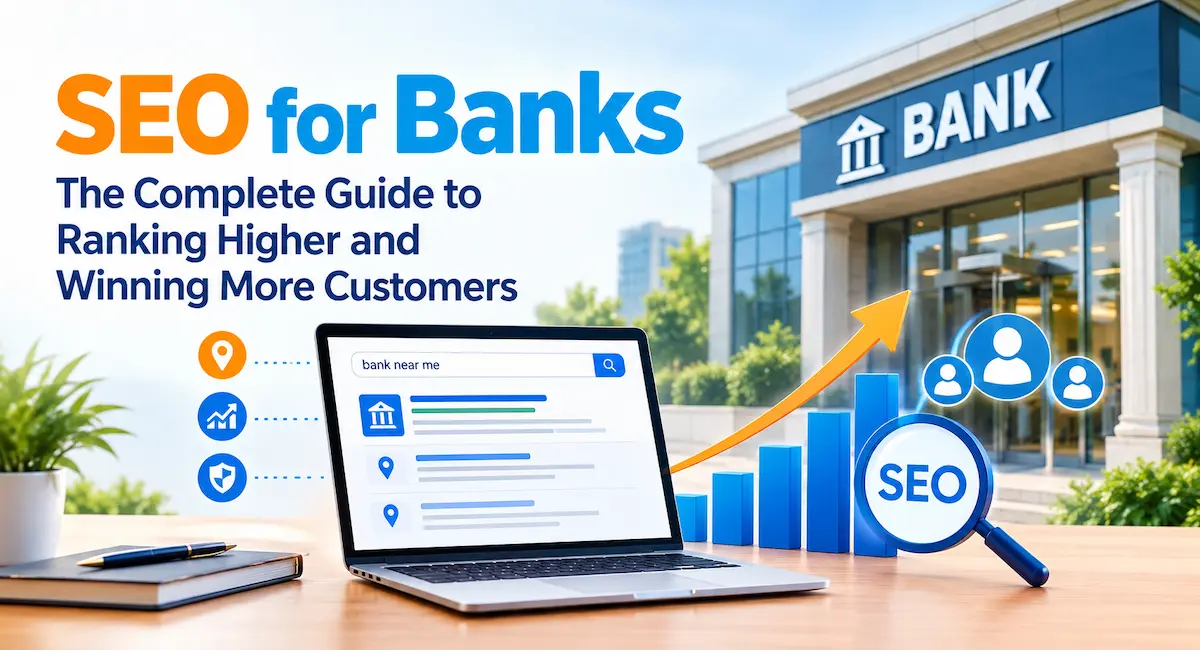
Most people no longer start their banking journey in a branch. They start with a search: “best savings account rates,” “small business loan near me,” or “how to refinance a mortgage.” If your bank does not appear on the first page for those queries, a fintech, a national competitor or an aggregator captures the customer instead.
SEO for banks is the practice of optimizing a bank’s website, content and local presence so that it ranks well in search engines and attracts qualified customers organically. It is more demanding than SEO in most industries, because banking falls under Google’s strictest quality standards, heavy regulation and intense competition.
This guide walks through exactly how to build a bank SEO strategy that is compliant, trustworthy and built to rank.
Why SEO Matters for Banks
Paid ads for financial keywords are some of the most expensive on the web, and ad clicks stop the moment the budget does. Organic search builds an asset that keeps working. The main benefits include:
- Lower long-term acquisition cost: Organic traffic compounds, while paid traffic must be bought repeatedly.
- Trust and credibility: Searchers tend to trust organic results, and trust is the core currency of banking.
- Full-funnel reach: You can capture people researching (“what is APY”), comparing (“best CD rates”) and ready to apply (“open business checking account”).
- Local dominance: Community banks and credit unions can outrank much larger institutions in their own markets.
- Better customer retention: Helpful educational content supports existing customers and reduces support load.
Understand the Rules: YMYL, E-E-A-T and Compliance
Google classifies financial content as YMYL (Your Money or Your Life), meaning content that could affect a person’s financial stability. These pages are held to a higher standard, and Google’s quality guidelines emphasize E-E-A-T: Experience, Expertise, Authoritativeness and Trustworthiness.
How banks can demonstrate E-E-A-T
- Show named authors with credentials (CFPs, CPAs, mortgage specialists, compliance officers).
- Add a “reviewed by” line and a last-updated date on financial advice pages.
- Publish clear About, Contact, Leadership and Licensing pages.
- Cite primary sources such as the Federal Reserve, FDIC, CFPB, NCUA or central bank publications.
- Display security, privacy and regulatory information prominently.
Keep content compliant
Search optimization never overrides regulation. Before publishing, have compliance review pages for:
- Required disclosures (rates, fees, terms, APY accuracy)
- Deposit insurance statements and official signage rules
- Fair lending and equal housing language
- Avoiding misleading or unsubstantiated claims (such as “best” or “guaranteed” without support)
Build a workflow where SEO, marketing and compliance teams review content together. It slows publishing slightly but prevents costly rework.
Step 1: Build a Bank-Specific Keyword Strategy
Good keyword research maps real customer intent to specific pages.
Types of keywords to target
- Product keywords: “high-yield savings account,” “business checking,” “home equity loan.”
- Informational keywords: “how does compound interest work,” “what is a credit score,” “how much house can I afford.”
- Comparison keywords: “savings account vs money market account,” “fixed vs variable mortgage rate.”
- Local keywords: “bank in [city],” “commercial lender near me,” “[town] mortgage rates.”
- Branded keywords: your bank’s name plus “login,” “routing number,” “branch hours,” “reviews.”
How to research them
- Use tools such as Google Search Console, Google Keyword Planner, Semrush or Ahrefs.
- Study the search results page: if Google shows mostly comparison articles, a product page alone will not rank.
- Prioritize long-tail keywords with clear intent and lower competition, for example “business line of credit for restaurants.”
- Group keywords into topic clusters and assign each to one primary page to avoid keyword cannibalization.
Step 2: Optimize Core Product and Service Pages
Your product pages are the revenue pages, so they deserve the most care.
- One primary keyword per page, placed naturally in the title tag, H1, first paragraph and URL.
- Clear, scannable structure: features, eligibility, rates, fees, how to apply and FAQs.
- Unique content: avoid templated text copied across dozens of similar pages, which creates thin or duplicate content.
- Strong calls to action: “Open an account,” “Check your rate,” “Book an appointment.”
- Internal links to related products, calculators and guides.
- Descriptive title tags and meta descriptions that match search intent and invite clicks.
Step 3: Master Local SEO for Branches and Community Markets
For most banks, local SEO is the highest-return tactic. Searches like “bank near me” often trigger Google’s local pack and map results.
Local SEO checklist
- Claim and complete a Google Business Profile for every branch and ATM location, with accurate hours, services, phone numbers and photos.
- Keep NAP consistent: name, address and phone number must match across your website, directories and social profiles.
- Create a dedicated page for each branch with unique content: local team, nearby landmarks, community involvement and branch-specific services.
- Encourage and respond to reviews professionally, without sharing any customer financial details.
- Build local citations in relevant directories and local chamber of commerce listings.
- Add local schema markup (Local Business or the more specific Bank Or Credit Union type) to branch pages.
Step 4: Create Content That Builds Authority
Content marketing lets a bank rank for the thousands of questions customers ask before they ever choose a provider.
Content formats that work for banks
- Educational guides: first-time homebuyer guides, budgeting basics, how to build credit.
- Calculators and tools: mortgage, loan, savings growth and retirement calculators attract links and engagement.
- Glossaries and explainers: simple definitions for terms like APR, escrow or overdraft.
- Local market content: housing market updates, small business resources, community events.
- Video and webinars: helpful for complex topics and for appearing in video results.
Writing tips for financial content
- Answer the question directly in the first paragraph.
- Use plain language and explain jargon.
- Use H2 and H3 headings, short paragraphs and bullet lists.
- Update rate-sensitive and regulation-sensitive pages on a schedule.
- Never copy competitor text; original, expert-reviewed content performs better and avoids plagiarism problems.
Step 5: Fix Technical SEO and Security Fundamentals
A bank website must be fast, secure and easy for search engines to crawl.
Technical priorities
- HTTPS everywhere, with a valid certificate and no mixed-content warnings.
- Core Web Vitals: aim for good scores on Largest Contentful Paint (loading), Interaction to Next Paint (responsiveness) and Cumulative Layout Shift (visual stability).
- Mobile-first design: Google primarily uses the mobile version of pages for indexing.
- Clean site architecture: keep important pages within a few clicks of the homepage with logical URLs and breadcrumbs.
- XML sitemap and robots.txt: submit the sitemap in Search Console and make sure you do not accidentally block key pages.
- Canonical tags and redirects: prevent duplicate content from rate pages, tracking parameters and old URLs.
- Crawl control for secure areas: keep online banking login and account pages out of the index.
- Accessibility: compliant, accessible design supports both users and legal obligations.
Structured data
Schema markup helps search engines understand your pages. Useful types include Organization, Local Business or Bank Or Credit Union, Breadcrumb List, and Article. Note that Google has limited FAQ rich results to a small set of authoritative sites, so do not rely on FAQ markup for visibility, though FAQ sections still help users and can inform how search engines understand a page.
Step 6: Build High-Quality Backlinks
Links remain one of the strongest ranking signals, and in finance quality matters far more than quantity.
- Digital PR: share original data, such as local home-affordability studies, with journalists.
- Community partnerships: sponsor local events, schools and charities that link back to your site.
- Expert commentary: offer your economists or lenders as sources for news outlets and industry publications.
- Linkable assets: calculators, benchmark reports and in-depth guides earn natural links.
- Local business associations: chambers of commerce and trade groups often provide credible links.
Avoid paid link schemes and low-quality directories. Google’s spam policies target manipulative link building, and a penalty is especially damaging for a trust-based business.
Step 7: Optimize for AI Search and Rich Results
Google now surfaces AI-generated overviews for many informational queries. To remain visible:
- Provide clear, factual, well-structured answers that are easy to quote.
- Cover topics comprehensively, with original insight rather than generic summaries.
- Keep authorship, sources and dates transparent.
- Maintain accurate entity information (name, locations, leadership) across the web.
The same fundamentals that satisfy E-E-A-T also tend to support visibility in AI-driven results.
Step 8: Measure, Report and Improve
Track metrics that tie to business outcomes, not just rankings.
| Metric | Why it matters | Tool |
|---|---|---|
| Organic traffic and impressions | Overall visibility trend | Google Search Console, GA4 |
| Keyword rankings (by cluster) | Progress on target topics | Semrush, Ahrefs |
| Local pack visibility and profile actions | Branch discovery, calls, directions | Google Business Profile |
| Conversions (applications, appointments, leads) | Revenue impact | GA4, CRM |
| Core Web Vitals | User experience and ranking signal | Search Console, PageSpeed Insights |
| Backlink quality | Authority growth | Ahrefs, Semrush |
Review data monthly, run a deeper content and technical audit each quarter, and refresh underperforming pages rather than only publishing new ones.
Common SEO Mistakes Banks Should Avoid
- Publishing thin, duplicated product pages across many branches or products
- Ignoring local SEO and leaving Google Business Profiles unclaimed or inconsistent
- Letting compliance delays leave outdated rates or terms live on the site
- Hiding useful content behind logins or in PDFs that are hard to crawl
- Neglecting page speed because of heavy scripts, chat widgets or tracking tags
- Targeting only branded keywords instead of high-intent non-branded searches
- Skipping a migration plan during a website redesign, which can wipe out rankings
A Simple 90-Day SEO Plan for Banks
Days 1 to 30: Foundation
- Run a technical and content audit.
- Fix crawl errors, speed issues and duplicate content.
- Claim and correct every Google Business Profile.
- Complete keyword research and map keywords to pages.
Days 31 to 60: Optimization
- Rewrite and optimize priority product pages.
- Build or improve branch location pages.
- Add schema markup and strengthen internal linking.
- Set up conversion tracking.
Days 61 to 90: Growth
- Launch an educational content calendar with expert review.
- Start a local link building and digital PR campaign.
- Publish one calculator or interactive tool.
- Review results and plan the next quarter.
Frequently Asked Questions About SEO for Banks
How long does SEO take to work for a bank?
Most banks see meaningful movement within three to six months, with stronger results at six to twelve months. Competitive national keywords take longer than local ones.
Is SEO different for banks than for other businesses?
Yes. Banking is a YMYL category, so Google expects stronger evidence of expertise and trust. Compliance review, security requirements and strict accuracy standards also add steps that most industries do not face.
Do credit unions and community banks need SEO too?
Absolutely. Local SEO gives smaller institutions a real advantage against national brands, especially for branch, loan and small business searches.
What is the most important SEO factor for banks?
No single factor wins alone, but trust signals combined with helpful, accurate content and strong local presence form the foundation of nearly every successful bank SEO strategy.
Should banks use paid search as well as SEO?
Often yes. Paid search delivers fast results while SEO builds long-term, lower-cost traffic. Many banks use both and share keyword data between them.
Conclusion
SEO for banks rewards institutions that combine technical excellence, expert content and genuine trust. Start with a compliant foundation, dominate your local market, build helpful content around real customer questions and measure results against business goals. Done consistently, SEO becomes one of the most cost-effective ways to attract new account holders, borrowers and long-term relationships.